
The modern United States power grid is susceptible to a variety of vulnerabilities, ranging from aging infrastructure, increasing demand, and unprecedented interactions (e.g., distributed energy resources (DERs) generating energy back to the grid, etc.). In addition, the rapid growth of new technologies, such as the Internet of Things (IoT) affords promising new capabilities, but also accompanies a simultaneous risk of cybersecurity deficiencies. Coupled with an electrical network referred to as one of the most “complex systems” of all time, and an overall “D+rating from the American Society of Civil Engineers (ASCE), these caveats necessitate revaluation of the electrical grid for future sustainability.

Research Approach
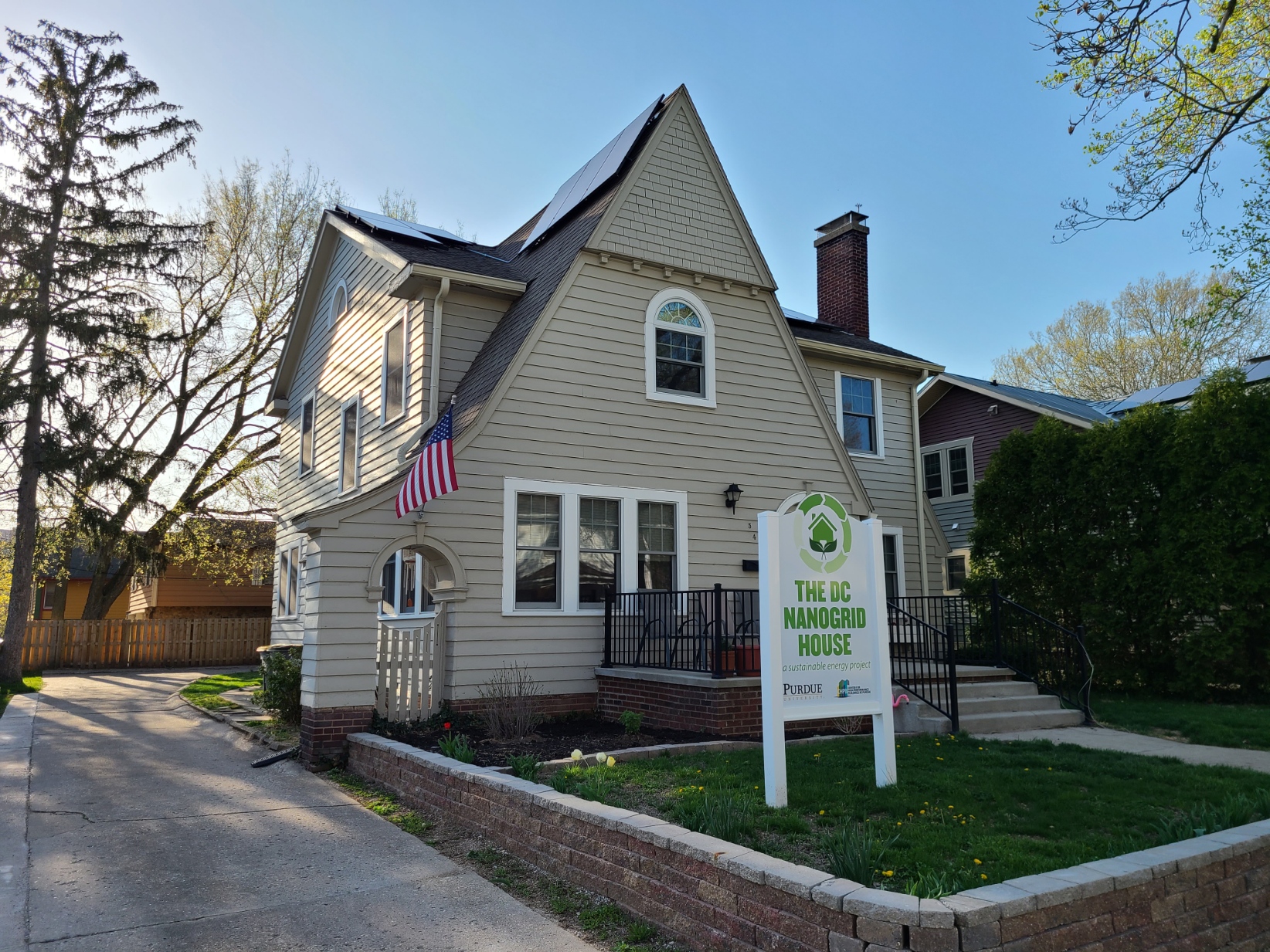
The DC Nanogrid House will serve as a living lab, occupied by three graduate students, who will live and work in the house full time. The project will involve an initial retrofit period of approximately 1- 2 months where the current house will be fully instrumented and modified with the appropriate baseline AC systems and appliances. The current house is a 1920’s era two story home located on Purdue’s campus. Following this initial retrofit period will be one year of baseline data collection.
The DC retrofit will be conducted after completion of the baseline data collection. This retrofit will include the installation of a central AC to DC converter that will provide DC power to the entire home from the AC utility grid. The retrofit will also involve the installation of solar panels on the roof and all new electrical wiring in the DC House Nanogrid house to distribute the various DC voltages that will be required.
The specifications of the DC distribution system within the home will be determined during the first year of the project through a comprehensive review and evaluation of current technologies and standards. The design of this DC distribution system is critical to the success of the DC Nanogrid House project. In parallel to the design of the DC distribution system will be the research and development of new direct DC appliances. The design of the DC distribution system and DC appliances will indeed be a collaborative effort, as the specifications of the distribution system will directly affect the design of the appliances and vice versa.
Following the DC retrofit of the house, the new DC appliances will be installed and studied for an additional year. The second year proposed to optimize the DC system based on the data gathered during the previous year. Tasks included in this optimization period would surround upgrading hardware or software in the DC distribution system, implementing improvements made to the DC appliances themselves, or performing additional research into areas such as smart control strategies and home energy management solutions. Over the course of this project, several years of data on a fully instrumented DC powered home will be collected and a number of new DC products will be developed and studied.
Purdue Project Team
Project Investigators (PIs)

Eckhard Groll
Eckhard A. Groll is the Reilly Professor of Mechanical Engineering at Purdue University and serves as the William E. and Florence E. Perry Head of Mechanical Engineering since July 1. He is world-renowned for his expertise in the fundamental thermal sciences as applied to advanced energy conversion systems, their components and working fluids with particular emphasis on vapor compression systems and positive displacement compressors.
Since joining Purdue, he has been the principal investigator (PI) or Co-PI on more than 120 research grants and more than 40 educational grants with a total budget of approximately $14 million from six different governmental agencies and more than 30 different industrial sponsors. He has advised more than a 100 graduate students and more than 150 undergraduate project students, visiting scholars, and visiting research associates. He has authored or co authored more than 370 archival journal articles and conference papers. He has been the co-author of 4 book chapters and the editor or co-editor of 7 conference proceedings. He serves as the Regional Editor for the Americas for the International Journal of Refrigeration.
Dr. Groll is a 2010-2011 Fellow of the American Council on Education (ACE) and a 2009-2010 Fellow of the Academic Leadership Program of the Committee on Institutional Collaboration (CIC-ALP). He has received numerous awards for his research and teaching excellence including most notably the 2018 J&E Hall International Gold Medal in Refrigeration by the Institute of Refrigeration (IOR) and the 2017 Peter Ritter von Rittinger International Heat Pump Award by the IEA Heat Pump Center. In addition, he was inducted into Purdue’s Book of Great Teachers
in 2008.
Davide Ziviani
Davide Ziviani is an Assistant Professor at the Ray W. Herrick Laboratories working with Prof. Eckhard A. Groll and Prof. James E. Braun, and serves as the Associate Director of the Center for High Performance Buildings (CHPB). He has extensive expertise in the modeling and testing of thermal systems and their components, including positive displacement compressors and expanders, organic Rankine cycles for waste heat recovery, as well as advanced conventional and disruptive HVAC&R technologies for residential and commercial applications.
Dr. Ziviani received his Doctoral degree in Electromechanical Engineering from the University of Ghent in Belgium, and Master’s and Bachelor’s degrees in Mechanical Engineering from the University of Ferrara in Italy. He began his research on waste heat recovery at San Diego State University. He has authored and co-authored more than 80 archival journal articles and conference papers. He has also the co-author of 4 book chapters. Dr. Ziviani is actively involved with ASHRAE and IIR. He serves as the
Research Chair of ASHRAE TC 8.1 and as the Vice-Chair of ASHRAE TC 8.3. Moreover, he serves also as a member of the editorial committee of the Knowledge Center on Organic Rankine Cycle (KCORC) technology. He is part of the organizing committees of the Rankine 2020 Conference to celebrate the bicentenary of the birth of William Rankine as well as of the 2020 Purdue Conferences at Purdue.

Lead Faculty

Kevin Kircher
Kevin Kircher is an Assistant Professor of Mechanical Engineering at Purdue University, where he contributes to the Center for High Performance Buildings at Herrick Laboratories. Prior to joining Purdue in 2022, Dr. Kircher completed a postdoctoral fellowship in Electrical Engineering at MIT and earned his PhD in Mechanical Engineering from Cornell University. Dr. Kircher’s research is dedicated to alleviating the adverse impacts of energy infrastructure on human well-being, including climate change, air and water pollution, and energy poverty. He specializes in developing optimization and control strategies for distributed energy resources such as heating and cooling systems, energy storage, electric vehicles, and solar panels, with a focus on their integration into the power grid.